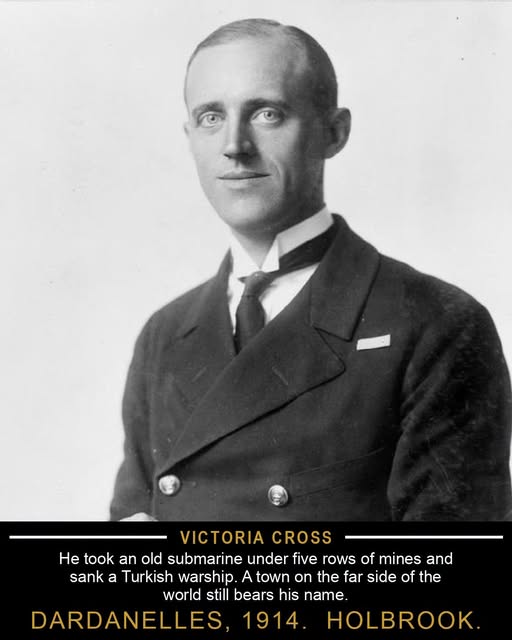
In an old submarine the navy had all but written off, he dived blind beneath five rows of mines, sank a Turkish warship, and stayed under the sea for nine hours to bring his crew safely home.
On the far side of the world, a whole town would later set aside its name and take his instead. It still carries it today.
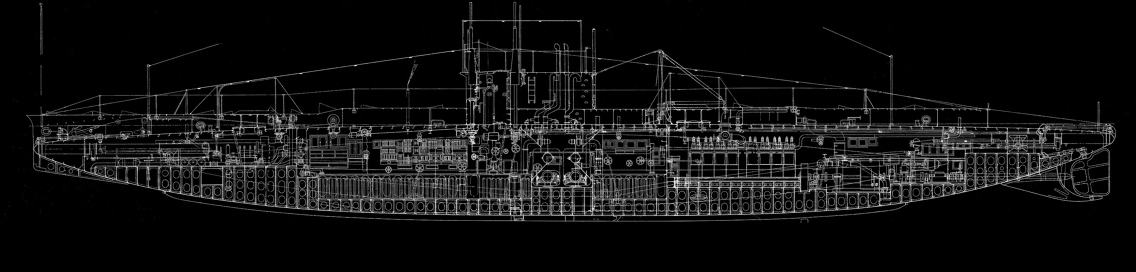
He was born at Southsea, on the Hampshire coast, in 1888. He went into the newest and most dangerous branch of the Royal Navy — the submarine service, where one mistake sent the whole crew to the bottom together, in the dark. By the end of 1913 he had command of his own boat: HM Submarine B11, built in 1906, small, slow, and already considered obsolete.
Then came the war, and the Dardanelles.
The strait was the most dangerous stretch of water a submarine could enter. A strong current ran through it. Five rows of mines were strung across the channel. And beyond them, set to guard the minefield, lay the old Turkish battleship Mesûdiye.
On the thirteenth of December, 1914, he took B11 in. He dived the little boat beneath the mines, holding her down by compass and nerve against the current. He brought her up on the far side, found the Mesûdiye, and fired. The torpedo struck home. The old battleship heeled over and went down in the shallow water; most of her crew were saved.
Then he had to get out. Turkish guns opened on him. He took B11 back down and turned for home through the same minefield, against the same current. By the time she surfaced, she had been under the water for nine hours. She came up clear, and every man aboard her was alive.
For that, he was awarded the Victoria Cross. He was the first submariner in history ever to receive it. His first lieutenant was given the Distinguished Service Order, and every other man of the crew was decorated too — an honour almost unheard of for a single small boat. France made him a knight of the Legion d'honneur.
But the strangest honour came from a place he had never seen. In the hills of New South Wales, in Australia, there was a small town called Germanton — named, years before, after an early German settler. In 1915, with the war on, the town set that old name aside. It chose a new one. It called itself Holbrook, after the young submarine captain on the other side of the world.
He went out to visit them, three times across his life. The town has guarded the link for more than a hundred years. Today a full-size submarine sits in a park in the middle of Holbrook — more than a hundred miles from the nearest sea — so that nobody passing through will forget why the town carries the name it does.
He lived a long, quiet life after the war. He came back to uniform for a second war, then chaired the family printing firm, and at the end ran a farm in Sussex. His son was killed in the Second World War. He himself died in the summer of 1976, an old man a long way from the sea.
In Australia they know exactly who he was. There is a town that bears his name, a submarine in a park, his medals kept and shown with pride. In the country he actually fought for, most people reading this will never have heard of him.
He was the first man ever awarded the Victoria Cross beneath the sea. He took an obsolete little submarine under five rows of mines, and brought every one of his men home alive.
His name was Norman Holbrook. A town on the far side of the world has carried it for a hundred years.